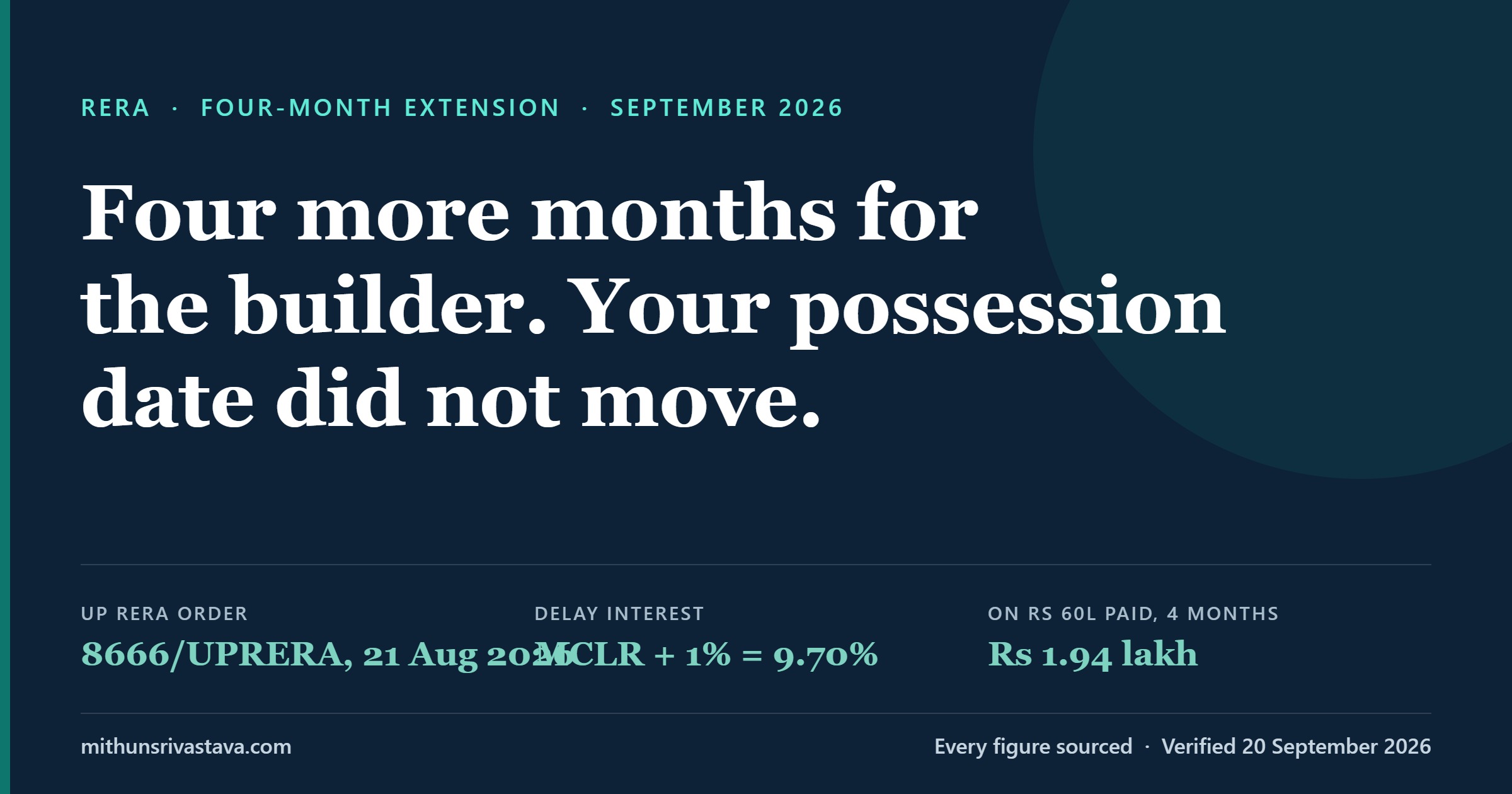
The short answer. Between 31 July and 21 August 2026, one central advisory and a series of state RERA orders gave delayed housing projects across India a four-month extension. If you are an allottee waiting for a flat, you have probably been told your possession date has moved.
It has not. The extension applies to the project’s registration and to the completion timeline recorded with the regulator. UP RERA’s order says so in terms, in a paragraph written precisely to stop this misreading: the date of possession stipulated in your Agreement for Sale “shall not stand extended or altered”, and delay interest continues to run.
This article sets out what the orders actually say, quotes the operative paragraph, shows what four months of delay interest is worth in rupees, and flags where one state’s order is drafted more protectively than another’s.
What actually happened
FACT The Ministry of Housing and Urban Affairs issued an advisory to all Real Estate Regulatory Authorities, OM No. 17024/66/2018-HOUSING UD/E-9042100, dated 31 July 2026. It advised authorities that, in the light of delay attributed to force majeure conditions arising from the West Asia situation, they may issue orders extending registration and the corresponding completion timelines of registered projects whose completion, revised completion or extended completion date falls on or after 28 February 2026, for four months, through a common order rather than requiring each promoter to apply separately.
State authorities then issued their own orders. Two are quoted in full below because we read both documents end to end. They are not identical, and the differences matter.
| Authority | Order and date | Projects covered | Application needed |
|---|---|---|---|
| UP RERA | No. 8666/UPRERA/Tech.Cell/2026-27, 21 August 2026, under section 37 | Completion date falling between 28-02-2026 and 31-10-2026, both inclusive | No, if compliant |
| HARERA Gurugram | No. 9/1-2026 HARERA/GGM (Admn), 11 August 2026, under sections 6, 7(3), 34(f) and 37 | Completion date falling on or after 28.02.2026, with no end date | No |
INTERPRETATION Read those two middle cells again. Haryana’s window has no closing date. Uttar Pradesh’s stops at 31 October 2026. A project due to complete in 2027 is inside the Gurugram order and outside the UP one. Nobody appears to be reporting this difference, and it decides whether a particular project is covered at all.
The paragraph that decides it
UP RERA’s order contains a paragraph written, plainly, to pre-empt exactly the misunderstanding now circulating. It is worth reading in full.
“The extension granted under these directions pertains solely to the validity of registration and completion timeline of the project as recorded with the Authority, and shall not, in any manner, alter the contractual rights and obligations of promoters and allottees under the Agreement for Sale. Accordingly, it is hereby provided that:
(a) The terms of the Agreement for Sale executed between the promoter and the allottees shall continue to remain unchanged and unaffected by the extension of registration of the project granted in the manner as provided herein above;
(b) The date of possession as stipulated in the Agreement for Sale shall not stand extended or altered on account of such extension;
(c) Interest for delay in possession, payable by the promoter to the allottee or interest on delayed payments by the allottee to the promoter, shall continue to be payable at the rate of the State Bank of India’s Marginal Cost of Lending Rate (MCLR) plus one per cent (MCLR + 1%), as prescribed under the UP RERA Rules.”
INTERPRETATION There are two different dates in your project, and they have never been the same thing. One is the completion date the promoter declared to the regulator when registering. The other is the possession date written into the agreement you signed. The orders move the first. They expressly do not move the second.
What four months of delay interest is actually worth
This is the part to work out in rupees, because it converts a legal point into a number you can hold on to.
FACT State Bank of India’s published MCLR, effective 15 September 2026, is 8.70% for the one-year tenor. At MCLR plus one per cent, delay interest runs at 9.70% a year.
| Amount you have paid | Per year | Per month | Over four months |
|---|---|---|---|
| ₹40,00,000 | ₹3,88,000 | ₹32,333 | ₹1,29,333 |
| ₹60,00,000 | ₹5,82,000 | ₹48,500 | ₹1,94,000 |
| ₹1,00,00,000 | ₹9,70,000 | ₹80,833 | ₹3,23,333 |
On sixty lakh already paid, and a possession date that has passed, the four months your promoter has just gained in regulatory terms are worth roughly ₹1.94 lakh to you in delay interest, which paragraph 5(c) says keeps running.
OPINION Two honest caveats, because this is the number people will want to quote. The UP RERA Rules prescribe MCLR plus one per cent, and the order does not name the tenor; we have used the one-year rate, which is the usual reading, and you should confirm the tenor applied in your own case. And delay interest arises only where possession is actually delayed beyond the agreed date. If your promoter is inside the agreed date, none of this is owed. Run your own figures with the EMI and interest calculator.
One state protected you in writing. The other did not.

FACT The Haryana order contains no equivalent of paragraph 5. We read it in full. It runs to three operative clauses: the automatic four-month extension, the statement that no separate application is required, and the confinement of the benefit to projects registered on or before 31.07.2026 whose extension or continuation was granted on or before 31.07.2026. There is no saving clause for the Agreement for Sale, no statement about the contractual possession date, and no mention of delay interest.
INTERPRETATION Silence is not the same as the opposite. A regulator extending a project’s registration is not rewriting private contracts and could not do so by administrative order; the legal position for a Gurugram allottee should be the same as for one in Noida. What differs is what you can put in front of a promoter who tells you otherwise. In Uttar Pradesh you can point to a sentence. In Haryana you have to argue from first principles.
OPINION If you are an allottee in Haryana, ask HARERA in writing to clarify whether the order affects contractual possession dates, and keep the reply. It costs you nothing and it converts an argument into a document.
The conditions, which most coverage has skipped
The UP extension is not automatic for everyone. It is automatic for compliant projects. Three conditions must be satisfied in respect of each eligible project:
- The sanctioned map, layout or building plan must have been valid and subsisting as on 28-02-2026.
- The promoter must have filed all Quarterly Progress Reports due up to the last quarter of the validity of registration.
- The promoter must have submitted the Annual Audit Report in Form REG-5 for FY 2024-25.
Where a promoter has not filed the QPRs or the audit report, the order requires them to clear the pending compliances first and then request the extension, which the Technical Division verifies before extending. And a project that already holds a Completion Certificate or an Occupancy Certificate is not eligible at all.
INTERPRETATION This is quietly useful to an allottee. The conditions are public, and two of the three are things you can check. If your promoter claims the four months, the QPRs and the annual audit report for FY 2024-25 should be on the authority’s portal. If they are not, the claim is premature.
What could go wrong
You accept a revised possession date in writing. If a promoter sends a letter recording a new possession date “in view of the RERA extension” and you sign it, you may have varied your own agreement. The order did not do that. Your signature might.
You stop counting. Delay interest accrues. It does not need to be claimed monthly to exist, but records help. Keep your payment receipts and the agreed possession date somewhere you can find them.
You assume your state issued an order. The central document is an advisory, not a direction. Each authority had to act. Do not assume your project is covered, and do not assume it is not.
You read “force majeure” as a finding about your project. It is not. It is a blanket administrative extension applied to every eligible project in the state, irrespective of why yours in particular is late.
You confuse this with an extension of RERA itself. Nothing in these orders changes any promoter obligation under the Act: the escrow requirement, the QPRs, the prohibition on altering sanctioned plans without consent, the liability for structural defects, and the allottee’s remedies all stand exactly as they did.
What we could not confirm
- Whether Maharashtra, Karnataka or Delhi issued equivalent orders. Secondary sources describe a MahaRERA order, but we could not retrieve it from MahaRERA’s own site, and we could not reach the Karnataka or Delhi RERA portals at all. We are not going to tell you a document exists on the strength of somebody else’s summary. If you are in one of those states, check your own authority’s orders page before relying on anything here.
- The MoHUA advisory itself. Its number and content are established beyond reasonable doubt, because three separate state orders quote it identically, but we could not find the OM published as a standalone document on the ministry’s own site.
- The exact MCLR tenor prescribed by the UP RERA Rules. The order says MCLR plus one per cent without naming the tenor. We have used the one-year rate and said so.
What to do this week
- Find your Agreement for Sale and write down the possession date stated in it. That is the date that matters.
- Check your state authority’s orders page to confirm whether an order was issued and what window it covers.
- Check whether your project’s completion date falls inside that window. In Haryana there is no closing date; in Uttar Pradesh the window closes at 31 October 2026.
- Check the portal for your project’s Quarterly Progress Reports and the FY 2024-25 annual audit report. If they are missing, the extension is not yet available to the promoter.
- Do not sign anything that records a new possession date without advice.
- Work out what delay interest is accruing on what you have already paid, and keep the calculation.
- If you are in Haryana, ask the authority in writing whether the order touches contractual possession dates, and keep the answer.
Terms used here
RERA, builder-buyer agreement, occupancy certificate, completion certificate, RERA escrow account, possession letter. The full glossary of Indian property terms has eighty-two entries.
Read next
What RERA changed, and what it did not is the companion piece to this one: what the regulator can actually do for you, and where it stops. Uttar Pradesh property rules and Haryana property rules carry the authority, portal and rule references for each state. Every dated change of this kind is logged on property law changes.
Sources and method
- U.P. Real Estate Regulatory Authority, Office Order under Section 37, No. 8666/UPRERA/Tech.Cell/2026-27, dated 21 August 2026. Three pages, read in full. Paragraph 5 quoted verbatim.
- Haryana Real Estate Regulatory Authority, Gurugram, Order No. 9/1-2026 HARERA/GGM (Admn), dated 11.08.2026, with endorsement No. 9/1-2026 HARERA/GGM (Admn)/8-13 of the same date. Read in full.
- Ministry of Housing and Urban Affairs advisory OM No. 17024/66/2018-HOUSING UD/E-9042100, dated 31 July 2026, as quoted in both orders above.
- State Bank of India, published tenor-wise MCLR effective 15 September 2026: one year 8.70%. Read on SBI’s own interest rates page, 20 September 2026.
- Real Estate (Regulation and Development) Act, 2016, sections 6, 7(3), 34(f), 37 and 83.
- Every rupee figure is our own arithmetic on the rate above, shown in full so you can check it. No figure here comes from a property portal, a listing site or a brokerage.
Last verified 20 September 2026. Orders and rates change; check the current position with your own state authority before acting.
This is a personal site. The views are the author’s own. Nothing here uses or reflects the data, systems or position of any employer, and it is not an official communication of any company. It is educational material, not legal or financial advice. Property decisions carry financial and legal risk, and you should verify independently and take your own professional advice.
Work out your own numbers
Free, no sign-up, and the assumptions are shown on every screen.
Leave a Reply