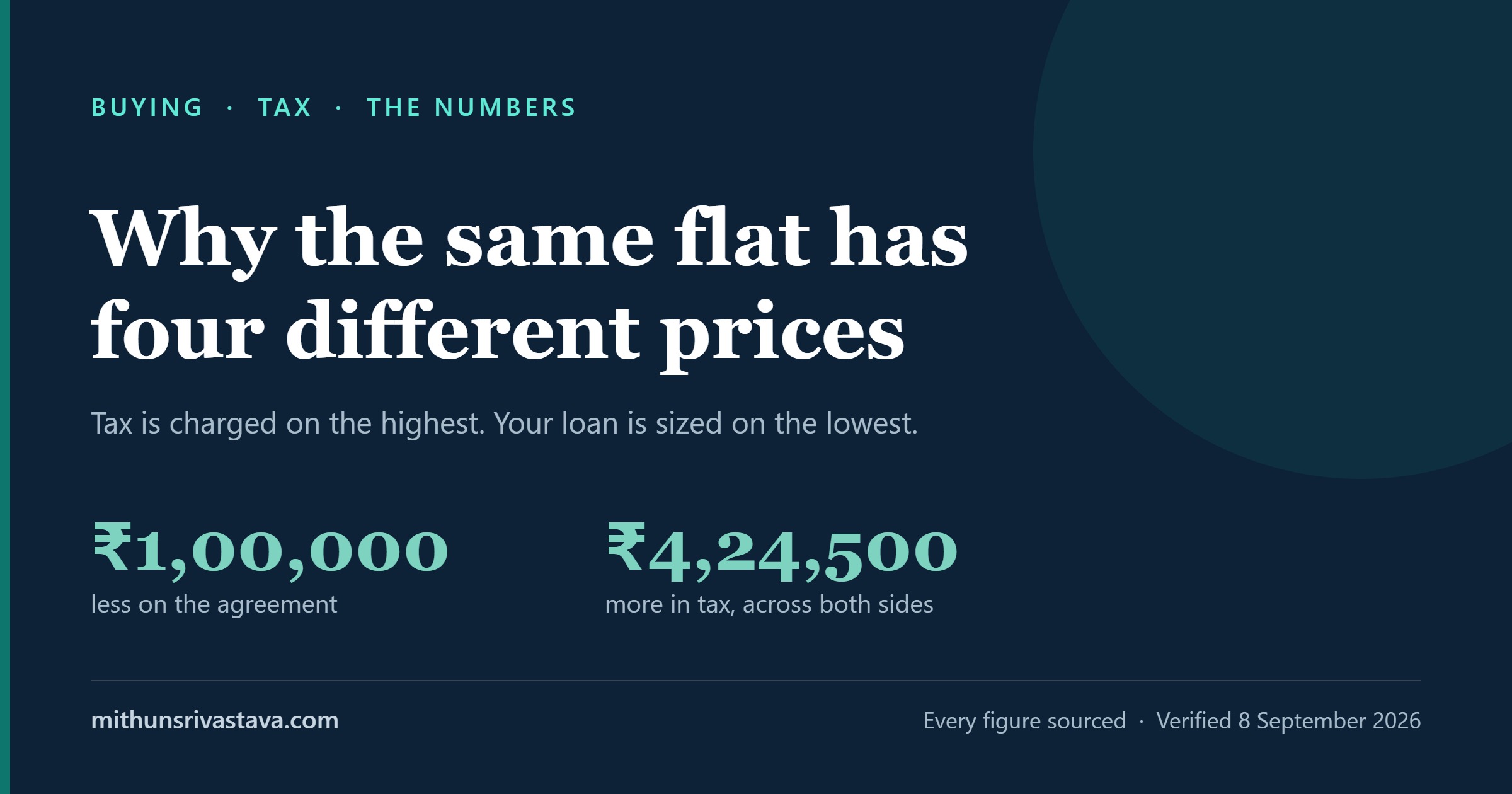
The short answer. A flat does not have a price. It has four, and they are set by four different people who never meet: the seller sets the asking price, the state government sets the circle rate, you and the seller together set the agreement value, and the bank’s empanelled valuer sets the lending value. Tax is charged on the highest of the first three. Your loan is sized on the lowest. And the gap between them is where almost every unpleasant surprise in an Indian property deal actually lives.
The single most expensive mistake is writing an agreement value more than 10% below the circle rate. Cross that line by one rupee and the entire gap becomes taxable income for the buyer and extra capital gain for the seller. It is a cliff, not a slope — and the worked example below shows a case where paying ₹1 lakh more saves the two sides ₹4.2 lakh in tax between them.
1. The asking price
This is the only one of the four that has no legal status at all. It is a number a seller chose, usually by looking at what a neighbour claimed to have got, and it is the number that dominates every conversation until the money moves.
OPINION In eighteen years I have almost never seen an asking price derived from anything a valuer would recognise. It is anchored on the highest transaction anyone in the building can remember, adjusted upward for the seller’s own emotional attachment and downward only under pressure. Treat it as an opening position, not information.
The asking price matters for exactly one reason: it is the starting point from which the agreement value gets negotiated, and the agreement value is the number the tax system reads.
2. The circle rate — the government’s floor
FACT Every state publishes a minimum value per square metre for every locality, below which a property is presumed — for stamp duty purposes — not to have been sold. The name changes by state: circle rate in Delhi and Uttar Pradesh, collector rate in Haryana, ready reckoner rate in Maharashtra, guidance value in Karnataka, jantri in Gujarat. The mechanism is the same everywhere.
Two things follow from that, and most buyers know only the first.
- Stamp duty is charged on the higher of the agreement value and the circle-rate value. Writing a lower number on the deed does not reduce the duty. It only reduces what you can later prove you paid.
- The circle rate is a floor, not a valuation. It is often stale. Delhi’s circle rates were last revised in 2014; Maharashtra’s ready reckoner is revised annually. In a slow micro-market the circle rate can sit above what anyone will actually pay, which is where the tax problem in section 3 comes from.
Circle rates, how often they are revised, and who publishes them are set out state by state in our state property rules pages — Uttar Pradesh, Delhi, Haryana, Maharashtra and Karnataka — each with the department that issues them and the date we last checked.
3. The agreement value — the number the tax system reads
This is the number written into the sale deed, and it is the one that decides four separate liabilities: stamp duty, registration fee, the buyer’s income tax, and the seller’s capital gains tax.
The cliff nobody explains
FACT Under the Income-tax Act, 2025, two provisions bite when the agreement value falls below the circle-rate value.
- The buyer — section 92(2)(m)(ii). If the stamp duty value exceeds the consideration by more than the higher of ₹50,000 or 10% of the consideration, the whole excess is taxed in the buyer’s hands as income from other sources.
- The seller — section 78. If the stamp duty value exceeds 110% of the consideration, the stamp duty value is deemed to be the full value of consideration for computing capital gains.
INTERPRETATION Written differently, the two tests bite at exactly the same point. “Excess more than 10% of consideration” and “stamp duty value more than 110% of consideration” are the same inequality. So the moment one side crosses the line, so does the other. There is no arrangement in which only one of you is caught.
And note the word whole. This is not a slab where only the amount above 10% is taxed. Cross the threshold and the entire gap is charged.
The arithmetic, in full
Take a flat whose circle-rate value is ₹1,00,00,000. Here are two deals that differ by one lakh rupees.
| Deal A | Deal B | |
|---|---|---|
| Agreement value | ₹90,00,000 | ₹91,00,000 |
| Excess of circle rate over price | ₹10,00,000 | ₹9,00,000 |
| 10% of the agreement value | ₹9,00,000 | ₹9,10,000 |
| Is the excess above the threshold? | Yes | No |
| Buyer’s taxable income under s.92(2)(m)(ii) | ₹10,00,000 | Nil |
| Buyer’s tax on it at 30% plus 4% cess | ₹3,12,000 | Nil |
| Seller’s deemed consideration under s.78 | ₹1,00,00,000 | ₹91,00,000 |
| Extra capital gain forced on the seller | ₹9,00,000 | Nil |
| Seller’s tax on it at 12.5% long-term | ₹1,12,500 | Nil |
| Extra tax across the two sides | ₹4,24,500 | Nil |
INTERPRETATION The seller took ₹1,00,000 less in Deal A and the two of them paid ₹4,24,500 more in tax for it. Our arithmetic, on the rates and thresholds cited above; the buyer’s figure assumes the 30% slab and the seller’s assumes a long-term gain taxed at 12.5%. Change the slab and the numbers move — the cliff does not.
This is the single most useful thing to know before you agree a price. If the deal is anywhere near the circle rate, work out 110% of the price you are about to write, and check it against the circle-rate value before you shake hands, not after.
Our stamp duty and registration calculator gives you the duty on the higher of the two values, and the capital gains calculator shows what the deemed consideration does to a seller’s liability.
The withholding tax reads the same number
FACT Under section 393(1) of the Income-tax Act, 2025 — which carries forward what was section 194-IA — the buyer must deduct 1% at source where the consideration or the stamp duty value is ₹50 lakh or more. The deduction is computed on whichever of the two is higher.
INTERPRETATION In Deal A above, the buyer pays ₹90,00,000 and must deduct ₹1,00,000 — more than 1% of what actually left his account. Buyers routinely deduct 1% of the cheque, get a short-deduction notice months later, and pay interest on the difference. It is one of the most common notices in Indian residential property, and it is entirely avoidable.
4. The bank’s valuation — the number you can borrow against
The fourth price is set by a valuer the bank empanels, and neither you nor the seller sees how it is arrived at. It matters for one reason: the loan is sized on it, not on what you agreed to pay.
FACT The RBI’s Master Circular on Housing Finance is explicit that the cost the loan-to-value ratio is measured against does not include the duty: “banks should not include stamp duty, registration and other documentation charges in the cost of the housing property they finance so that the effectiveness of LTV norms is not diluted.” The single exception is a house costing not more than ₹10 lakh, where those charges may be added in.
INTERPRETATION For every transaction that is not an affordable-housing case, this means the entire stamp duty and registration bill is money you must have in cash. It cannot be borrowed inside the home loan. On an ₹80 lakh flat in an urban Haryana municipality that is roughly ₹6 lakh of duty and fee, on top of your down payment, and it is the commonest reason a sale falls over three days before registry.
INTERPRETATION Lenders in practice cap the loan at about 90% of value up to ₹30 lakh, 80% between ₹30 lakh and ₹75 lakh, and 75% above that. And where the valuer’s figure comes in below your agreement value, the percentage is applied to the lower number. A buyer who agreed ₹95 lakh on a flat the valuer marks at ₹88 lakh does not lose 20% of ₹95 lakh — he loses 20% of ₹88 lakh and the entire ₹7 lakh difference as well.
5. The fifth number: what actually leaves your account
None of the four prices above is what the flat costs you. That number is the agreement value plus stamp duty, plus the registration fee, plus GST if it is an under-construction purchase, plus the society transfer charge, plus the legal and valuation fees, plus the brokerage and the GST on the brokerage.
OPINION If you take one habit from this article, make it this: never talk about a property in terms of its asking price again. Talk about the all-in number. It is usually 8% to 12% higher, it is the number your bank account will actually see, and quoting it early is the fastest way to find out whether a deal is real.
What most people miss
- The circle rate can be above the market. In slow micro-markets — older colonies, stalled projects, stressed resale — the honest price is below the government’s floor. The tax code does not care. You will pay duty on a value nobody would pay, and you may be taxed on a gain nobody made.
- The date of the agreement can freeze the circle rate. Section 78 allows the stamp duty value on the date of the agreement to be used instead of the date of registration — but only if the agreement date and the registration date differ and part or all of the consideration was received on or before the agreement date through a banking or online mode. Cash on the agreement date destroys the concession.
- Nobody in the transaction is paid to tell you this. The sub-registrar collects duty on the higher value and moves on. The bank cares about its own security cover. The tax consequence surfaces when a return is processed, often more than a year later, by which time the other side is unreachable.
What could go wrong
- You agree a price 12% below circle rate to save duty, and receive a notice adding the full gap to your income.
- You deduct 1% of the cheque instead of 1% of the circle-rate value, and pay interest on the short deduction.
- The valuer marks the flat below your agreement value and your loan falls short with three days to registry.
- You budget the down payment but not the duty, because your loan sanction letter never mentioned it — it could not, under the RBI rule quoted above.
Before you agree a price, ask these
- What is the circle-rate value of this exact unit — carpet area times the notified rate for this locality — not the seller’s estimate?
- Is the price I am about to agree at least 91% of that number? (That is what “within 110%” means from the other direction.)
- Will the agreement date and the registration date differ, and if so will I have paid part of the consideration by bank transfer on or before the agreement date?
- Is the 1% TDS being computed on the higher of my price and the circle-rate value?
- What is the bank’s valuer’s figure, and what does my loan become if it lands 8% below my price?
- What is the all-in number — price, duty, registration, GST, transfer charge, brokerage, and GST on brokerage?
Who pays whom in an Indian property deal traces every rupee that leaves a buyer’s account and where each one lands. If you are buying under construction, our RERA possession reminder keeps the date the builder committed to in the registered agreement in front of you.
What we could not confirm
- The 90% / 80% / 75% loan-to-value ceilings are given here as what lenders apply in practice. The current RBI Master Circular we were able to read expresses these bands as risk-weight thresholds rather than as hard sanctioning ceilings, and we could not open rbi.org.in directly on the date of writing to check whether the ceiling language of the 2015 circular survives verbatim. Treat the bands as a planning guide and ask your lender for its own policy.
- Sources differ on the form: the challan-cum-statement for property TDS has historically been Form 26QB, and at least one practitioner source describes it as carried into Schedule B of Form 141 under the 2025 Act, while the Income Tax Department’s own public page still describes Form 26QB. Check the current form on the TIN portal before you file.
- The Income Tax Department’s public guidance pages were, on the date of writing, still framed around section 194-IA of the 1961 Act rather than section 393(1) of the 2025 Act. The substance is the same; the numbering you will see quoted may not be.
Sources
- Income-tax Act, 2025, section 78 — special provision for full value of consideration; 110% safe harbour. Checked 8 September 2026.
- Income-tax Act, 2025, section 92(2)(m)(ii) — immovable property received for inadequate consideration; higher of ₹50,000 or 10%. Checked 8 September 2026.
- Income-tax Act, 2025, section 393(1) — deduction of tax on transfer of immovable property, 1% where consideration or stamp duty value is ₹50 lakh or more, on whichever is higher; in force from 1 April 2026. Checked 8 September 2026.
- Income Tax Department, TDS — purchase of immovable property, incometaxindia.gov.in — no deduction where both the consideration and the stamp duty value are below ₹50 lakh. Checked 8 September 2026.
- Reserve Bank of India, Master Circular — Housing Finance, RBI/2023-24/08, DOR.CRE.REC.No.06/08.12.001/2023-24, 3 April 2023, section on quantum of loan. Checked 8 September 2026.
- State-level circle rate, collector rate, ready reckoner, guidance value and jantri sources are cited individually on the relevant state rules page.
Educational content, not legal or tax advice. Tax positions here turn on facts we cannot see — your slab, your holding period, your state’s rate on the day you register. Verify every figure against the primary source before you act on it, and take professional advice on anything material.
Work out your own numbers
Free, no sign-up, and the assumptions are shown on every screen.
Leave a Reply