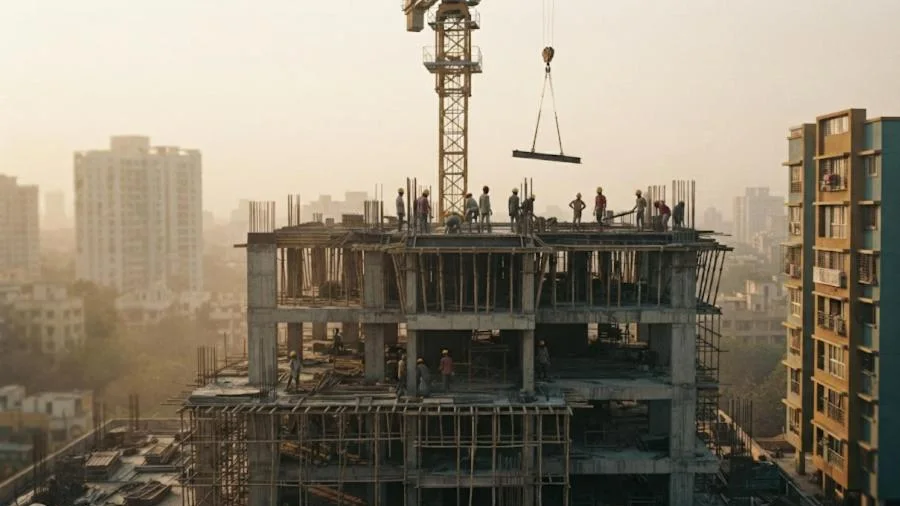
The short answer. An Indian housing project is paid for by three sources, in roughly this order: the builder’s own money and the landowner’s land at the start; buyers’ payments through construction; and borrowed money — bank construction finance, or costlier private credit — to fill the gaps. Banks are generally not allowed to finance a private developer’s purchase of land, so the riskiest stage is paid for with the most expensive money.
For a buyer this matters because your payments are part of the financing. RERA requires 70% of what buyers pay to sit in a separate account used only for land and construction. The other 30%, the order in which the builder spends, and how much is borrowed, decide whether your tower is finished on time. This article explains the stack, with a worked example, and the questions that reveal how a project is funded.
The four stages, and who pays for each
| Stage | Main costs | Usual sources of money | Risk to a buyer |
|---|---|---|---|
| 1. Land | Buying the land, or signing a development agreement with the owner | Builder’s own equity; the landowner’s land in return for a share of flats or revenue; private equity or structured debt from non-bank lenders | Title disputes, landowner disagreements. Bank money usually cannot be used here. |
| 2. Approvals | Plan sanction, development charges, premiums to the development authority, RERA registration | Equity, private credit, early bookings | Unpaid authority dues can later block registration of your flat. |
| 3. Construction | Structure, finishing, services, common areas | Buyers’ instalments through the RERA account; bank construction finance against future receivables | Slow sales mean slow money, and construction slows with it. |
| 4. Completion | Occupancy certificate, handover, society formation | Final instalments from buyers; unsold inventory sold at completion | A builder short of cash at the end may hand over without an occupancy certificate. |
What the law requires of the builder
FACT Under section 4(2)(l)(D) of the Real Estate (Regulation and Development) Act, 2016, a promoter must deposit 70% of the amounts realised from allottees in a separate bank account, to be used only for the cost of land and construction of that project. Money can be withdrawn only in proportion to the percentage of completion, against certificates from an engineer, an architect and a practising chartered accountant, and the accounts must be audited each year. Some states allow a lower percentage where the full cost of land and construction is already covered; check your state’s rules.
FACT Under section 13 of the same Act, a promoter cannot take more than 10% of the cost of a flat as an advance or application fee before a written agreement for sale is registered.
FACT The Reserve Bank of India’s long-standing rules on housing finance bar banks from lending to private builders to buy land, other than in limited cases involving public agencies. Banks may finance construction, typically against the project’s receivables. Since a 2013 RBI direction, banks also may not release a buyer’s home loan upfront to a builder for an under-construction flat; disbursement has to follow the stages of construction.
INTERPRETATION Put those rules together and the shape of the problem appears. The land stage cannot use cheap bank money, so it is funded by equity or expensive private credit. Construction can be funded partly by buyers, but only 70% of their money is ring-fenced and only as fast as construction progresses. A builder who has paid too much for land, or borrowed too expensively, comes under pressure in the middle of the project — which is exactly where most delays happen.
What the numbers say: a worked example
The figures below are an illustration, not data about any real project. Change the proportions and the conclusion does not change.
Total sales value if every flat sells: ₹200 crore. Assume construction costs ₹90 crore, spent roughly in line with progress.
Case A — sales on track. At 40% construction, half the flats are sold and those buyers have paid 40% of their price under a construction-linked plan: 100 × ₹1 crore × 40% = ₹40 crore collected. The RERA account holds 70% of that, ₹28 crore. Construction to date has cost 40% of ₹90 crore = ₹36 crore. The builder must find the other ₹8 crore from a bank loan or its own funds.
Case B — sales stall. Same stage, but only 30% of flats are sold: 60 × ₹1 crore × 40% = ₹24 crore collected, ₹16.8 crore in the RERA account. The gap is now ₹19.2 crore, more than twice as large, at the same point in construction.
INTERPRETATION This is why the sales pace of a project tells you more about your possession date than the brochure does. A builder in Case B has three choices: borrow more, slow construction, or push sales with discounts and schemes. Each leaves a trace you can look for.
What most people miss
Your money and the escrow are not the same thing. Only 70% of what you pay is ring-fenced. The other 30% is legitimately available for marketing, overheads, interest and profit. That is how the law was designed, not a loophole — but it means “my money is in escrow” is only partly true.
The quarterly reports tell you the funding story. Every registered project has to upload progress and financial details to the state RERA portal. Compare the percentage of flats booked with the percentage of construction completed. A project that is 70% built and 20% sold is being funded by someone other than buyers, and that someone is usually charging interest.
Generous payment schemes are a funding signal. Plans that ask for very little until possession move the financing burden back onto the builder. They can be genuine offers, but they also tell you the builder wants bookings more than cash right now. OPINION Ask why the scheme exists before you treat it as a discount.
A development agreement creates a second owner. Where the builder has not bought the land outright, the landowner keeps a share of the flats or revenue. Disputes between the two are a common cause of stalled projects. Ask for the development agreement and check that it is registered.
What could go wrong
Diversion between projects. The 70% rule was introduced after builders were found using one project’s collections to buy land for the next. In the Amrapali case in 2019, the Supreme Court relied on a forensic audit that found buyers’ money had been diverted, cancelled the builder’s registrations and directed that the unfinished projects be completed under court supervision. The rule reduces this risk; it does not remove it, because the 30% is still free and certificates can be wrong.
Expensive debt. When a builder borrows from non-bank lenders at high rates, interest can consume the margin. Projects funded this way are more vulnerable to a sales slowdown.
Insolvency. If the company fails, buyers become creditors in an insolvency process. Since 30 October 2026 that process must run project by project, with a separate account and a cost-to-complete report for each one — see our entry on property law changes. It is still slow, and it is not a substitute for checking before you buy.
The alternative: buy what is already built
A ready flat with an occupancy certificate takes the financing risk off the table entirely. You usually pay more per square foot, but no GST is charged on a flat sold after its occupancy certificate is issued, and you can inspect exactly what you are buying. INTERPRETATION For a buyer who cannot afford a delay — because of rent, a school move or a loan that starts charging full EMI on disbursement — the price premium of a finished flat is often cheaper than the cost of waiting. Compare the two on the buy versus rent calculator, counting the rent you will pay while you wait.
Questions that reveal how a project is funded
- Is the land owned outright or under a development agreement? Ask for the title deed or the registered development agreement.
- Which bank holds the RERA account, and is there a construction loan on the project? A charge or mortgage on the project land shows up in the encumbrance certificate and should be disclosed on the RERA portal.
- Will the lender give a no-objection certificate for my flat? If the project is mortgaged, you need the lender’s release of your unit before registration.
- How many units are booked, and what percentage of construction is complete? Then check both against the latest quarterly report on the state RERA portal.
- Are all dues to the development authority paid? In several states, unpaid authority dues have blocked registration of flats for years after possession.
- Does the builder have other projects running late? The state RERA portal lists every project a promoter has registered. Delays tend to travel together.
Who this suits, and who should walk
An under-construction purchase suits a buyer who can wait, has checked that sales and construction are moving together, and has confirmed that the land title and authority dues are clean.
Walk away if the builder will not tell you who holds the land, if the RERA portal’s quarterly reports are missing or stale, or if construction is far ahead of bookings with no explanation of how the gap is being paid for.
Terms used here
RERA, RERA escrow account, development agreement, encumbrance certificate, occupancy certificate, tripartite agreement. The full glossary covers every term on a project document.
Read next
What RERA changed, and what it did not covers the regulator’s powers and their limits. Your builder just got four more months; your possession date did not explains this year’s force-majeure extensions. Who pays whom in an Indian property deal is the overview of every payment in a purchase. State-by-state rules, including where each RERA portal lives, are on state property rules.
Sources and method
- Real Estate (Regulation and Development) Act, 2016, sections 4(2)(l)(D) (70% account, withdrawals against certified completion, annual audit) and 13 (10% cap before a registered agreement for sale).
- Reserve Bank of India, Master Circular on Housing Finance, on the bar on bank finance for land acquisition by private builders; and RBI’s 2013 direction on upfront disbursal of housing loans under subvention-type schemes for under-construction property.
- Supreme Court of India, Bikram Chatterji v. Union of India, judgment of 23 July 2019 (the Amrapali case).
- Insolvency and Bankruptcy Board of India, Notification No. IBBI/2026-27/GN/REG155 dated 30 October 2026, on project-wise insolvency.
- The 200-flat example is our own illustration, with arithmetic shown. No figure on this page is drawn from any company’s data, and no developer is described.
Last verified 15 November 2026. State RERA rules differ on the escrow percentage and on what must be disclosed; check your own state’s rules and the project’s portal page before booking.
This is a personal site. The views are the author’s own. Nothing here uses or reflects the data, systems or position of any employer, and it is not an official communication of any company. It is educational material, not legal or financial advice. Property decisions carry financial and legal risk, and you should verify independently and take your own professional advice.
Work out your own numbers
Free, no sign-up, and the assumptions are shown on every screen.
Leave a Reply