RERA changed what a developer must disclose, what he may collect before signing, and what it costs him to appeal. It did not change what happens when he has run out of money.
The Act gave allottees a definition of carpet area, a 10% ceiling on pre-agreement collections, a five-year defect liability, a right to refund with interest, and a pre-deposit condition that makes a promoter’s appeal expensive. What it did not give them is an executing agency of its own. A RERA order is recovered as an arrear of land revenue — by the district administration, not the regulator — and it stops altogether when the promoter enters insolvency. Nine years in, that is still the gap, and a state regulator has said so in writing.
Part one: what the Act actually says
Most of what is written about RERA paraphrases it. The provisions themselves are short and worth reading in the original, because the paraphrases are where the errors get in.
| Section | What it does |
|---|---|
| 2(k) | Defines carpet area as “the net usable floor area of an apartment, excluding the area covered by the external walls, areas under services shafts, exclusive balcony or verandah area and exclusive open terrace area, but includes the area covered by the internal partition walls” |
| 3(1) | No promoter may advertise, market, book, sell or offer for sale without registering the project |
| 3(2)(a) | Exempts projects where the land “does not exceed five hundred square meters or the number of apartments … does not exceed eight inclusive of all phases” |
| 4(2)(l)(D) | 70% of amounts realised from allottees into a separate account in a scheduled bank, withdrawn in proportion to completion, certified by an engineer, an architect and a chartered accountant |
| 13(1) | No more than 10% of cost as advance without first entering into and registering a written agreement for sale |
| 14(3) | Five-year liability for structural and workmanship defects from the date of handing over possession, to be rectified within thirty days of notice |
| 18(1) | On failure to give possession by the agreed date, refund of the whole amount with interest if the allottee withdraws; interest for every month of delay if he stays |
| 40(1) | Unpaid interest, penalty or compensation “shall be recoverable … as an arrears of land revenue” |
INTERPRETATION Three precision points that the summaries lose.
The threshold in section 3(2)(a) is disjunctive. It says 500 square metres or eight apartments, not “and”. On the literal text, a project on 400 square metres with twelve apartments, or on 900 square metres with six, has an argument for exemption. States have taken divergent positions on it, and it remains live.
Section 13 is conjunctive. The agreement for sale must be both written and registered before more than 10% is collected. Taking 10% against an unregistered memorandum of understanding does not satisfy it, and that is exactly what a great deal of pre-launch collection still looks like.
The five years in section 14(3) runs from handing over possession, not from the occupancy certificate or the completion certificate; and the thirty days runs from the defect being brought to notice, not from when it appeared.
Part two: what changed, with the dates on the numbers
FACT As at the fifth meeting of the Central Advisory Council on 4 September 2025: 1,51,113 projects and 1,06,545 real estate agents registered nationally, and 1,47,383 complaints disposed of by regulatory authorities. Thirty-five states and union territories had established regulatory authorities, 29 had appellate tribunals, and 27 had appointed adjudicating officers.
We are dating that explicitly because it is the most recent official national figure we could obtain. The Unified RERA Portal launched at that meeting carries a live tracker; it was not reachable when we checked on 12 September 2026, so we are not printing a 2026 national number.
FACT At state level, UP RERA published its own 2025 figures: 308 projects registered in calendar 2025 against 259 in 2024, covering 84,976 units against 69,365, representing declared investment of ₹68,328 crore against ₹44,526 crore — a 53.5% increase in capital committed to registered projects in a single year.
OPINION That is the honest version of “RERA worked”. A regulated, disclosed, registered market of that size did not exist in 2015. Whether the disclosures are accurate is a different question, and Part three is about the answer.
Part three: what did not change
1. There is no RERA bailiff
Section 40(1) is the hinge of the whole enforcement problem, and it is a design choice rather than an accident. It does not empower the Authority to recover anything. It converts a RERA order into a revenue recovery, executed by the district administration — the Collector, the District Magistrate, the Tehsildar — an agency with no stake in RERA’s performance and a queue of its own priorities.
INTERPRETATION An allottee who wins at RERA has not won money. He has won a piece of paper that a different arm of government must now choose to act on. Every subsequent problem in this section follows from that separation.
FACT We could not obtain, from any acceptable source, national or state figures for recovery certificates issued against amounts actually recovered. Figures circulate widely in the property press; none of them traces to a regulator or a government publication, and we are not repeating them.
2. Insolvency switches RERA off — and a regulator has said so, with numbers
This is the strongest single document in this article, and it comes from a state authority rather than a commentator.
UP RERA advisory, 3 December 2025
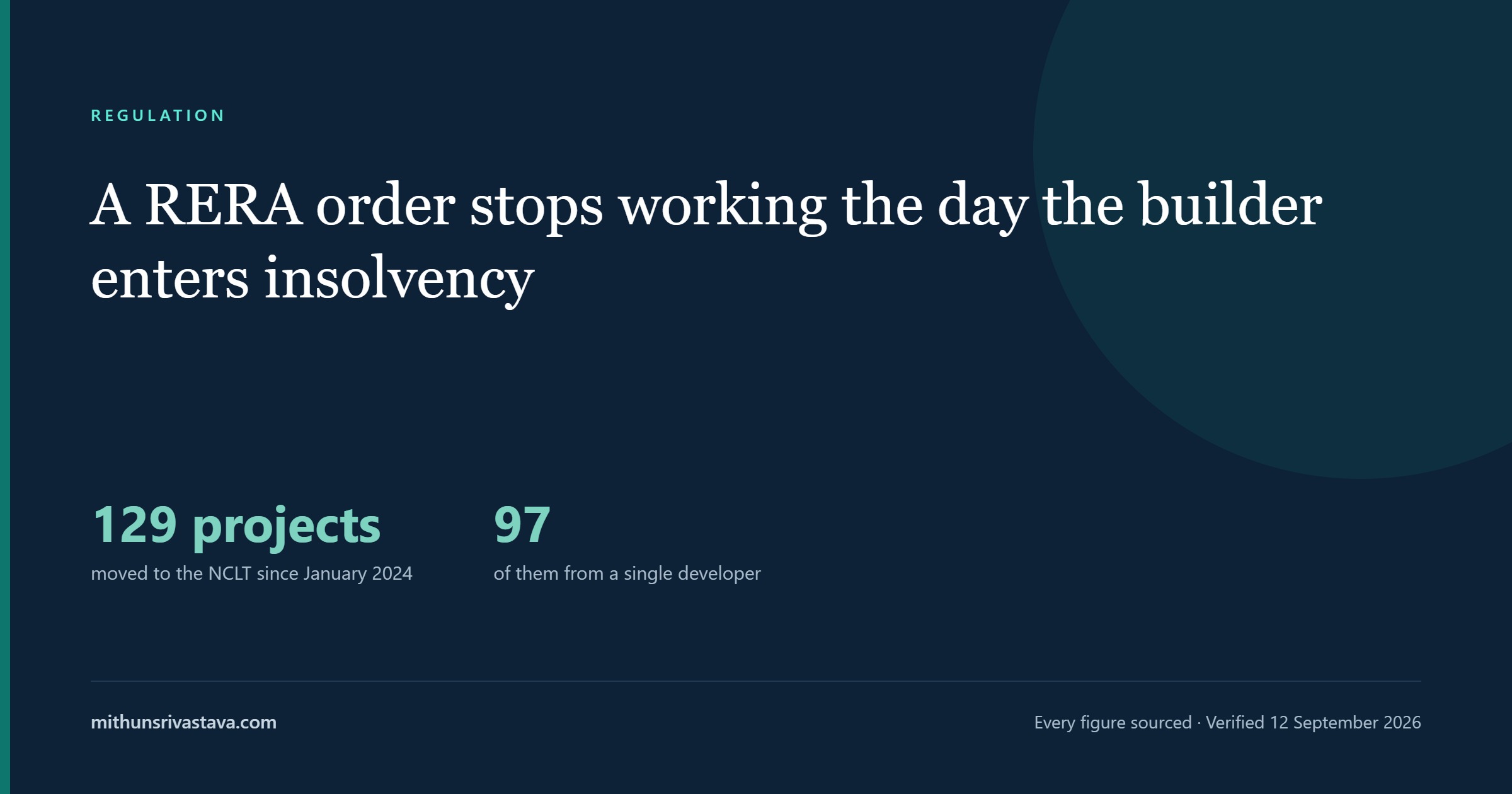
129 real estate projects belonging to 14 companies had entered the Corporate Insolvency Resolution Process before the NCLT since January 2024 — 97 of them belonging to a single developer. Once the moratorium under section 14 of the Insolvency and Bankruptcy Code takes effect, the authority stated, RERA “cannot take up or continue complaints, enforcement orders, or hearings related to these projects until the moratorium is lifted”. Affected homebuyers were directed to file claims with the Interim Resolution Professionals instead.
The legal reason sits in the Supreme Court’s decision in Pioneer Urban Land and Infrastructure Limited v. Union of India (Writ Petition (C) No. 43 of 2019, decided 9 August 2019), which upheld the amendment bringing homebuyers within “financial creditors” under section 5(8)(f) of the Code. As the Insolvency and Bankruptcy Board of India’s own published analysis of that judgment records, the Court reasoned that section 88 of RERA makes its provisions “in addition to and not in derogation of” other law while “no similar provision exists in the Code”, so “the Code as amended, must be given precedence over RERA” and “in the event of a clash, RERA must give way to the Code.”
INTERPRETATION Put the two together and you get the sharpest sentence in this whole subject. An allottee can win at RERA, obtain a recovery certificate, and still recover nothing — because the promoter’s insolvency moves the entire dispute into a collective proceeding in which he is one voice among thousands and controls none of it.
3. Where a state built a weaker parallel regime, the Supreme Court dismantled it
FACT In Forum for People’s Collective Efforts v. State of West Bengal (Writ Petition (C) No. 116 of 2019, Supreme Court of India, decided 4 May 2021), the Court struck down the West Bengal Housing Industry Regulation Act, 2017 as repugnant to RERA under Article 254. It held the state statute’s provisions were either directly inconsistent with the central Act or a virtual replica of it, that a state legislature cannot enact parallel legislation on a Concurrent List subject once Parliament has legislated, and that the state Act had neither been reserved for nor received Presidential assent under Article 254(2).
INTERPRETATION The dilution criticism usually aimed at RERA concerns state rules made under section 84, particularly how some states defined “ongoing project” so as to shrink the first proviso to section 3(1). We could not source those specific carve-outs to a government, parliamentary or judicial document, so we are not naming states. What is solidly established is the direction of travel: the courts have upheld RERA’s application to ongoing projects and struck down a state attempt to run its own softer version.
4. A large part of the market was never inside RERA at all
- Completed projects. The first proviso to section 3(1) requires registration only of projects ongoing at commencement “for which the completion certificate has not been issued”. A project holding a completion certificate in 2016 never entered the regime. In Newtech Promoters and Developers Pvt Ltd v. State of Uttar Pradesh (Civil Appeals 6745–6757 of 2021, decided 11 November 2021) the Supreme Court confirmed that already-completed projects fall outside RERA’s scope.
- Sub-threshold projects under section 3(2)(a) — and, given the “or”, arguably more of them than intended.
- Plotted developments, whose treatment varies by state because “apartment” and “building” are defined terms and a bare plot fits neither comfortably.
- The resale market entirely. RERA regulates promoters and agents. It does not regulate a private seller selling you his own flat, which is where a very large share of Indian transactions actually happen. If that is your transaction, the paperwork discipline has to come from you — see the document set every resale buyer must demand.
5. The forum you pick first is now the forum you are stuck with
This changed in February 2026, and it has not filtered through to most advice.
The established position, from Imperia Structures Ltd v. Anil Patni (2020), is that section 79 of RERA does not oust the jurisdiction of consumer fora: an allottee could proceed under the Consumer Protection Act notwithstanding RERA.
FACT In M/s Kabra and Associates & Ors. v. Rekha Rajkumar Hemdev & Ors. (Civil Appeal No. 6936 of 2023, Supreme Court of India, decided 4 February 2026), the Court held that complainants who had elected to proceed before the RERA Authority could not then switch: “having committed themselves in that regard, it was not open to them at that stage to opt for the other remedy available under the Consumer Protection Act, 2019.” It applied the election-of-remedies principle from Ireo Grace Realtech Pvt Ltd v. Abhishek Khanna.
INTERPRETATION Be precise about what this does and does not do, because it is already being overstated. Kabra does not discuss section 79 and does not refer to Imperia. It does not abolish the consumer remedy. Concurrency survives — but the choice has become a one-way door, and the first filing fixes the forum for that cause of action.
OPINION That makes the forum decision the single most consequential early move in a homebuyer dispute. It is also, almost always, made by an unadvised buyer choosing whichever complaint is cheapest or fastest to file online. Combine it with the insolvency point above and the worst case is concrete: a buyer picks RERA, wins, the promoter enters insolvency, and he has neither an executable order nor the consumer remedy he gave up.
6. In some states there is still nobody to appeal to
FACT On the September 2025 official count, 35 states and UTs had a regulatory authority, 29 had an appellate tribunal, and 27 had appointed an adjudicating officer.
INTERPRETATION The second gap is worse than it sounds, and the reason is doctrinal. Newtech divided the functions: the Authority determines refund and delay interest under section 18(1), but only the adjudicating officer may adjudicate compensation under sections 12, 14, 18(2)–(3) and 19. In the eight jurisdictions that had not appointed one, the compensation remedy is, on the Supreme Court’s own division of labour, unavailable in practice — not refused, simply unreachable.
Part four: what actually bites — section 43(5)
There is one provision in RERA that works exactly as intended, and it is the one least discussed.
The proviso to section 43(5) says an appeal by a promoter “shall not be entertained” without the promoter first depositing with the Appellate Tribunal “at least thirty per cent. of the penalty, or such higher percentage as may be determined by the Appellate Tribunal, or the total amount to be paid to the allottee including interest and compensation imposed on him, if any, or with both”.
INTERPRETATION It is widely misstated as “30%”. It is not. Thirty per cent is the floor for a penalty. Where the order is a refund order, the deposit condition bites on the whole sum payable to the allottee, interest included. Here is what that difference looks like:
| The order below | Amount | Pre-deposit to appeal |
|---|---|---|
| Penalty imposed on the promoter | ₹20,00,000 | ₹6,00,000 (30%, or more if the Tribunal fixes it higher) |
| Refund order — principal paid by the allottee | ₹62,00,000 | |
| Refund order — interest, illustrative at 10% a year for four years | ₹24,80,000 | |
| Total payable to the allottee | ₹86,80,000 | ₹86,80,000 — the whole of it |
The interest figure there is our own illustration on a stated assumption, not a sourced rate; the actual rate is prescribed by state rules and is typically tied to a bank lending benchmark. The point is structural, and it holds at any rate: a promoter cannot use an appeal as a cheap delaying tactic, because the delay has to be funded up front. The Supreme Court upheld the condition in Newtech.
OPINION If you take one practical thing from this article, take this: the pre-deposit is the allottee’s real leverage, and it exists only once there is an order. That is an argument for pursuing the order rather than settling early on the promoter’s terms — provided the promoter is solvent. If he is not, everything above about insolvency applies instead, and settling early may genuinely be the better outcome. Knowing which situation you are in is the whole game.
Five things about RERA a first-time buyer would not know
1. A registration number is a filing receipt, not an approval. Nothing in sections 3 to 5 requires the Authority to verify that the land title is clean or that the project is sanctioned. The promoter files declarations and documents under section 4; the Authority registers. “RERA-registered” does not mean “RERA-vetted”, and the ordinary reader’s inference to the contrary has no basis in the Act.
2. Registration expires. It is granted for the period the promoter himself declared, extendable under section 6 and revocable under section 7. Selling or advertising under a lapsed registration contravenes section 3(1). Check the expiry date on the registration, not just its existence.
3. The 70% rule throttles the rate of withdrawal, not the destination of the money. The account is a promoter-controlled account at a scheduled bank, not an escrow held by the regulator. The discipline is the three-professional certification, and what it tests is whether a withdrawal is in proportion to the percentage of completion. And RERA registers projects: section 3(2)(a) expressly contemplates phasing, so where a developer registers phases as separate projects, each has its own separate account and the rule polices withdrawals within each one. INTERPRETATION That is a design limitation visible on the face of the statute, not an allegation about anyone’s conduct.
4. Section 19(10) is used against buyers. The allottee “shall take physical possession of the apartment … within a period of two months of the occupancy certificate issued”. Buyers routinely withhold possession to press snagging complaints, and promoters use the two-month duty to start maintenance charges running and to argue the allottee caused the delay. Snag in writing, take possession under protest, and keep the two things separate.
5. Quarterly progress reports are mandatory, and occasionally the failure is punished. UP RERA’s own press-release index records a penalty of over ₹2.43 crore imposed on two promoters for failure to upload quarterly progress reports, announced in March 2026, and the authority ran compliance webinars on quarterly reporting in August 2026. OPINION A regulator does not run webinars on a duty everyone is already performing. Before you buy, look at whether the project’s quarterly updates are actually on the state portal and current. It is free, it takes five minutes, and a project that has stopped filing is telling you something.
The one-paragraph version. RERA is very good at the front of a transaction and weak at the back of one. Use it as a disclosure regime: check the registration, its expiry, the declared completion date, the quarterly filings and the carpet area, and insist on a registered agreement for sale before paying past 10%. Do not rely on it as a recovery mechanism against a developer who is already in trouble — by the time you need that, the useful question is whether he is solvent, not whether you are right.
Questions to ask before you book
- What is the project’s RERA registration number, and what is its expiry date?
- Are the quarterly progress reports on the state authority’s portal, and how current is the latest one?
- What completion date did the promoter declare to the Authority — not what the brochure says?
- Is the agreement for sale going to be registered before I pay more than 10%?
- Is the price quoted on carpet area as defined in section 2(k), and does the agreement say so?
- Has any complaint been decided against this promoter, and was any recovery certificate issued?
- Is any company in this group currently before the NCLT?
- Is there an appellate tribunal and an adjudicating officer functioning in this state today?
Sources, and when each was checked
- Real Estate (Regulation and Development) Act, 2016, ss.2(k), 3, 4(2)(l)(D), 6, 7, 12, 13, 14(3), 18, 19, 40, 43(5), 44 and 88 — text published by the Uttar Pradesh Real Estate Regulatory Authority, up-rera.in. Checked 12 September 2026.
- National registration, disposal and institutional figures — Press Information Bureau, “Union Minister Shri Manohar Lal launches Unified RERA Portal at 5th Meeting of Central Advisory Council”, 4 September 2025, pib.gov.in. Checked 12 September 2026. Figures are as at that date.
- Uttar Pradesh registration data for 2025 — U.P. Real Estate Regulatory Authority press release dated 7 January 2026, up-rera.in. Checked 12 September 2026.
- Insolvency advisory — U.P. Real Estate Regulatory Authority, “UP RERA Issues Advisory as 129 Projects Move to NCLT”, 3 December 2025, up-rera.in. Checked 12 September 2026.
- Quarterly progress report penalty — U.P. Real Estate Regulatory Authority press release index, March 2026 entry, up-rera.in. Checked 12 September 2026.
- Pioneer Urban Land and Infrastructure Ltd v. Union of India, Writ Petition (C) No. 43 of 2019, Supreme Court of India, 9 August 2019 — as analysed by the Insolvency and Bankruptcy Board of India, ibbi.gov.in. Checked 12 September 2026.
- M/s Kabra and Associates & Ors. v. Rekha Rajkumar Hemdev & Ors., Civil Appeal No. 6936 of 2023, Supreme Court of India, 4 February 2026 — official judgment, Supreme Court of India. Checked 12 September 2026.
- Newtech Promoters and Developers Pvt Ltd v. State of Uttar Pradesh, Civil Appeals 6745–6757 of 2021, Supreme Court of India, 11 November 2021. Forum for People’s Collective Efforts v. State of West Bengal, Writ Petition (C) No. 116 of 2019, Supreme Court of India, 4 May 2021. Imperia Structures Ltd v. Anil Patni, Supreme Court of India, 2 November 2020. Checked 12 September 2026.
- Could not confirm: current national RERA totals for 2026 (the Unified RERA Portal tracker was unreachable on 12 September 2026); per-state registration and disposal figures for Maharashtra, Karnataka, Haryana, Delhi and Tamil Nadu; and any figure for recovery certificates issued against amounts recovered, nationally or in any state. Widely circulated press figures for these exist and are deliberately not reproduced.
Related reading: Who pays whom in an Indian property deal and Why the same flat has four different prices. Terms used here are defined in the glossary, and the state-by-state regulatory position is on the state rules pages.
This is a personal site. The views here are the author’s own. Nothing on this page uses any employer’s data, and it is not an official communication of any company. Content is educational, not legal advice; every figure should be verified against the source cited before you act on it.
Work out your own numbers
Free, no sign-up, and the assumptions are shown on every screen.
Leave a Reply