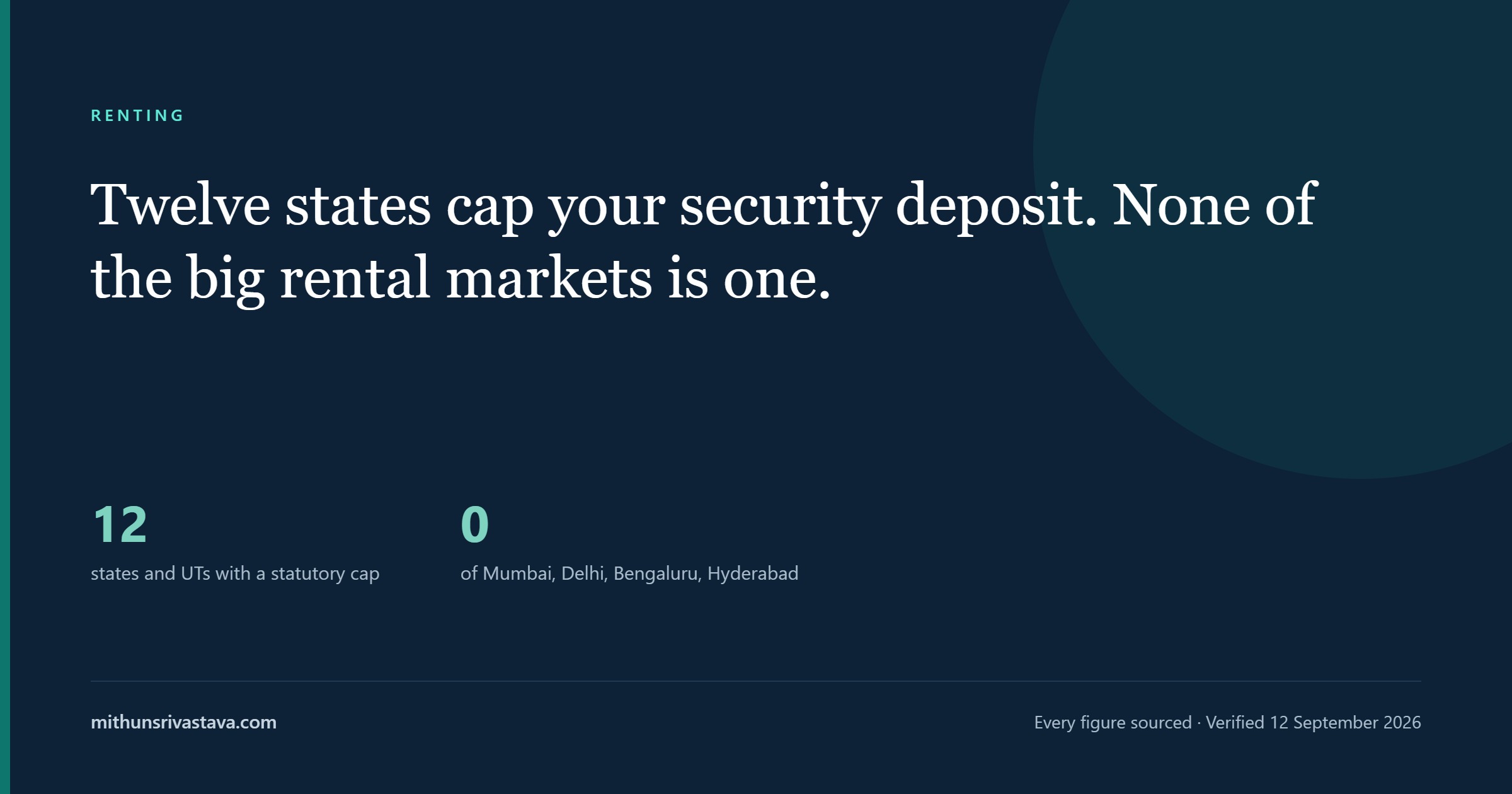
In most of India there is no legal ceiling on a rental security deposit at all. Twelve states and union territories have enacted a tenancy statute that caps it. None of them is Maharashtra, Delhi, Karnataka, Telangana, West Bengal, Gujarat, Haryana, Punjab, Kerala or Rajasthan — which between them contain almost every large rental market in the country.
Where a cap exists it is usually two months’ rent for a home and six for a shop or office. In Tamil Nadu and Andhra Pradesh it is three months, and even that is a default the agreement can override. Everywhere else the number is whatever you sign, and getting it back is a civil debt claim, not a tenancy remedy.
The map nobody publishes
The Model Tenancy Act, 2021 is not law. It is a model the Union Cabinet approved “for circulation to all States / Union Territories for adaptation by way of enacting fresh legislation or amending existing rental laws suitably.” It binds no one until a state enacts it, and the most recent central statement we could find on which states had done so is a Rajya Sabha answer from July 2022 naming four.
That answer is four years out of date. We rebuilt the list from the India Code statute repository by enumerating every tenancy-titled Act and Regulation state by state, and then reading each one. Here is where it stands.
| State or UT | Statute | Residential cap | Non-residential | Note |
|---|---|---|---|---|
| Assam | Assam Tenancy Act, 2021 | 2 months | 6 months | Enacted; draft rules only, July 2025 |
| Uttar Pradesh | U.P. Regulation of Urban Premises Tenancy Act, 2021 | 2 months | 6 months | Urban areas only |
| Uttarakhand | Uttarakhand Tenancy Act, 2021 | 2 months | 6 months | Routinely omitted from published lists |
| Arunachal Pradesh | Arunachal Pradesh Tenancy Act, 2022 | Not verified | Not verified | Act confirmed; s.11 text unread |
| Andaman & Nicobar Islands | Tenancy Regulation, 2023 | 2 months | 6 months | Presidential regulation |
| Dadra & Nagar Haveli and Daman & Diu | Tenancy Regulation, 2023 | 2 months | 6 months | Presidential regulation |
| Lakshadweep | Lakshadweep Tenancy Regulation, 2023 | 2 months | 6 months | Presidential regulation |
| Jammu & Kashmir | J&K Tenancy Act, 2025 | 2 months | 6 months | Assented 1 November 2025 |
| Tamil Nadu | T.N. Regulation of Rights and Responsibilities of Landlords and Tenants Act, 2017 | 3 months | 3 months | “Save an agreement to the contrary” |
| Andhra Pradesh | A.P. Residential and Non-Residential Premises Tenancy Act, 2017 | 3 months | 3 months | “Save an agreement to the contrary” |
| Chandigarh | Assam Tenancy Act, 2021, as extended | 2 months | 6 months | See the note below — contested |
| No statutory cap: Maharashtra, Delhi, Karnataka, Telangana, West Bengal, Kerala, Gujarat, Rajasthan, Madhya Pradesh, Chhattisgarh, Bihar, Jharkhand, Odisha, Punjab, Haryana, Himachal Pradesh, Goa, Puducherry, Sikkim, Nagaland, Manipur, Mizoram, Meghalaya, Tripura and Ladakh. | ||||
FACT The Model Tenancy Act cap, where a state has adopted it, reads: the deposit “shall not exceed two months rent, in case of residential premises; and not exceed six months rent, in case of non-residential premises,” and “shall be refunded to the tenant on the date of taking over vacant possession of the premises from the tenant, after making due deduction of any liability of the tenant.”
INTERPRETATION Read that refund clause carefully. It is not “within thirty days”, which is what most secondary writing says. It is simultaneous with handover. There is no grace period written into the statute at all.
Chandigarh, and why we are hedging it
FACT The Ministry of Home Affairs records, in its own monthly achievements document, the “Extension of the Assam Tenancy Act, 2021 (Assam Act No. XXXI of 2021) to UT of Chandigarh”, notified by S.O. 2265(E) dated 6 May 2026. That much is official. India Code now carries the Assam Act as a Chandigarh entry.
OPINION Beyond that, we are not going to pretend to certainty. It has been reported that the Punjab and Haryana High Court kept the notification in abeyance in late May 2026 because rules had not been framed and no Rent Authority had been notified, and that implementing rules were notified in Chandigarh in the second week of September 2026. We could not obtain the court’s order or the Chandigarh notification from any official source, and this site does not print consequential legal claims from press reports. If you rent in Chandigarh, treat the position as unsettled and ask the Estate Office directly.
The three states everybody assumes are covered, and are not
Maharashtra — the law expressly permits large deposits
Mumbai’s ten- and twelve-month deposits are not a grey area or a market abuse. They are lawful, and the statute says so in terms. Section 56 of the Maharashtra Rent Control Act, 1999 makes it lawful for “the landlord or any person acting or purporting to act on behalf of the landlord to receive any fine, premium or other like sum or deposit or any consideration in respect of the grant or renewal of lease of any premises.”
INTERPRETATION That was a deliberate reversal. The predecessor statute, the Bombay Rents, Hotel and Lodging House Rates Control Act, 1947, criminalised pugree. Maharashtra legalised premium and deposit in 1999 and set no ceiling. There is no number a Mumbai landlord can ask for that is too high as a matter of law.
Delhi — a cap that applies to almost nobody
The Delhi Rent Control Act, 1958 does prohibit pugree and does cap advance rent. Section 5(2)(b) bars a landlord, “except with the previous permission of the Controller,” from receiving “any sum exceeding one month’s rent of such premises as rent in advance.”
Then section 3(c) says nothing in the Act applies “to any premises, whether residential or not, whose monthly rent exceeds three thousand and five hundred rupees.” That figure was inserted in 1988 and has never been revised.
INTERPRETATION Essentially no rented property in Delhi today falls under the Act. Delhi has a rent control statute on the books and, in substance, a pure contract market. There is a refund remedy in section 13, but the Controller may act only “on an application made to him within a period of one year from the date of such payment” — and a deposit paid at the start of a three-year tenancy is time-barred long before the dispute over it arises.
Karnataka — excluded twice over, and the viral claim is false
The Karnataka Rent Act, 1999 (Karnataka Act 34 of 2001) is in force. It has no cap on deposits: its unlawful-charges provision, section 11, restrains only the tenant side from taking money to relinquish a tenancy, and there is no equivalent of Delhi’s section 5(2) restraining the landlord.
And in any case it does not reach Bengaluru’s rental stock. Section 2(3)(e) excludes premises whose rent exceeds ₹3,500 a month in the scheduled areas, and section 2(3)(f) excludes premises constructed or substantially renovated for a period of fifteen years.
FACT There is no Karnataka two-month deposit cap. Headlines to that effect refer to the Karnataka Rent (Amendment) Bill, 2025, which is a decriminalisation measure: it makes the Controller an adjudicating officer, omits section 53, and converts the offences in section 54 into civil penalties at higher money amounts. It does not touch section 11, section 2, or any deposit provision.
OPINION This is currently the most repeated false claim in Indian rental writing, and it matters, because a Bengaluru tenant who believes there is a statutory cap will negotiate as though the law is on their side. It is not. The negotiating leverage is the market, not the statute.
What a ten-month deposit actually costs you
No official source publishes customary deposit levels for Indian cities. We looked: the National Sample Survey collects rent paid, not deposits lodged; the Census records tenure, not amounts; the Reserve Bank and the National Housing Bank publish sale-price indices; and the two states holding the most registered agreements — Maharashtra and Tamil Nadu — publish no aggregates from them. Every widely circulated city figure traces back to listing sites. FACT We are not reprinting them.
What we can do is our own arithmetic on what an interest-free deposit costs the person who lodges it. Assume the money would otherwise have earned 7% a year, compounded, which is a conservative fixed-deposit-like return and is an assumption, not a source:
| Deposit | Held 1 year | Held 2 years | Held 3 years | Equivalent rent uplift over 3 years |
|---|---|---|---|---|
| ₹2,00,000 | ₹14,000 | ₹28,980 | ₹45,009 | ₹1,250 a month |
| ₹5,00,000 | ₹35,000 | ₹72,450 | ₹1,12,521 | ₹3,126 a month |
| ₹10,00,000 | ₹70,000 | ₹1,44,900 | ₹2,25,043 | ₹6,251 a month |
INTERPRETATION A ten-month Bengaluru deposit on a ₹1,00,000 flat is a ₹10 lakh interest-free loan to the landlord, and it adds roughly ₹6,250 a month to the true cost of that tenancy — a little over 6% on top of the rent. That number is the argument to make in a negotiation, because it converts an abstract lump sum into a monthly figure both sides understand. If you are on the other side of it, the rental yield calculator shows what the deposit does to a landlord’s actual return.
What a landlord may lawfully deduct
Two regimes, and they differ.
Outside the tenancy statutes: Transfer of Property Act, section 108(m)
The default rule, which applies “in the absence of a contract or local usage to the contrary”, is that the tenant must restore the property “in as good condition as it was in at the time when he was put in possession, subject only to the changes caused by reasonable wear and tear or irresistible force”; and where a defect has been caused by the tenant’s act or default, he “is bound to make it good within three months after such notice has been given.”
INTERPRETATION Two things are usually missed. Reasonable wear and tear is carved out by the statute itself, so the burden is on the landlord to show the damage exceeds it. And the default is a right to cure, not an automatic right to deduct: notice first, three months to fix it, then a claim.
In a Model Tenancy Act state: read the Second Schedule
The Schedule divides maintenance between the parties “unless otherwise agreed in the tenancy agreement”, and the allocation will surprise most Indian tenants:
| The landlord | The tenant |
|---|---|
| Structural repairs, except damage caused by the tenant | Tap washers and taps; drain cleaning |
| Whitewashing of walls and painting of doors and windows | Water closet, wash basin, bath tub, geyser repairs |
| Changing and plumbing pipes when necessary | Circuit breaker, switches and socket repairs |
| Internal and external wiring and related maintenance | Knobs and locks; fly-nets; window and door glass panels |
| Electrical equipment repairs, and gardens or open spaces let to the tenant |
FACT In a Model Tenancy Act state, and absent a contrary clause in the agreement, repainting is the landlord’s job. The routine Indian practice of docking a flat “painting charge” from every departing tenant’s deposit is a deduction for something the statute assigns to the other side. Equally, replacing the door locks, the tap washers, the fly-nets and the broken window pane is squarely the tenant’s, and a landlord can deduct those.
On the three questions people actually ask:
- Unpaid electricity and water — yes. These are liabilities of the tenant, and the statutory formula permits deduction of “any liability of the tenant”.
- Repainting — no, in an adopting state and absent a clause moving it. Outside one, ordinary discolouration is wear and tear under s.108(m); repainting to cover tenant-caused damage is not.
- The landlord’s brokerage on re-letting — no. Nothing in the tenancy statutes, the Transfer of Property Act, or the Maharashtra, Delhi or Karnataka Acts makes the landlord’s own agent fee a tenant liability, unless the agreement expressly makes it one on early exit.
OPINION The single best clause a tenant can insist on is a dated, photographed inventory and condition schedule annexed to the agreement and signed by both parties. It costs an hour. It converts a subjective argument at handover into a comparison.
How you actually get it back
Three routes, depending on where you are, and none of them is the consumer forum.
In a state that has adopted the Model Tenancy Act pattern, the architecture is genuinely good on paper: Rent Authority, Rent Court and Rent Tribunal; civil courts barred; disposal to be endeavoured within sixty days with written reasons if longer; no more than three adjournments per party; execution within thirty days; and enforcement by attaching the opposite party’s bank accounts. Court fees on an application to the Rent Authority are those of an interlocutory application — nominal.
INTERPRETATION Two problems sit under that. First, a drafting gap: the section that gives the Rent Authority Rent Court powers lists sections 4, 9, 10, 14, 15, 19 and 20 — and the security deposit section and the refund-with-interest section are not in that list. A repair-related deduction dispute has a clear route; a bare refusal to refund appears to belong to the Rent Court. Second, and more seriously, in Assam, Uttarakhand, Arunachal Pradesh and Chandigarh we could find no evidence that the Rent Authority, Rent Court or Rent Tribunal has actually been constituted. A statute with a sixty-day timeline and no forum to hear you in is not a remedy.
And there is a trap in the adopting states that catches the careless. The statute provides that the information filed with the Rent Authority “shall be conclusive proof of the facts relating to tenancy” and that “in the absence of any statement of information, the landlord and the tenant shall not be entitled to any relief under the provisions of this Act.” Combine that with the civil-court bar and a tenancy that was never filed with the Rent Authority may leave the tenant with no forum at all. Filing is due within two months of the agreement.
Everywhere else, a withheld deposit is a plain money debt. The route is a civil suit for recovery, and where the claim arises on a written agreement for a liquidated sum — which a deposit clause in a written agreement usually is — a summary suit under Order XXXVII of the Code of Civil Procedure is materially faster, because the defendant must obtain leave to defend.
Not the consumer forum. OPINION A landlord letting premises is not rendering a “service” to a tenant in the way the Consumer Protection Act contemplates; the relationship is a lease or licence governed by the Transfer of Property Act and the applicable rent statute. Where a tenancy statute is in force, the civil-court bar and the Rent Court’s exclusive jurisdiction independently oust the consumer fora. Consumer fora do hear builder-and-allottee disputes about construction and allotment, which is a different relationship entirely. Filing a deposit claim in a consumer forum usually costs a tenant several months and ends in a dismissal on maintainability.
Four things a layperson would not know
1. In Mumbai, an unregistered agreement helps the tenant, not the landlord. Section 55(2) of the Maharashtra Rent Control Act puts the duty to register on the landlord and provides that in the absence of a registered written agreement, “the contention of the tenant about the terms and conditions … shall prevail, unless proved otherwise.” In a dispute over how large the deposit was, the tenant’s version is presumed correct. Section 55(3) adds imprisonment up to three months or a fine up to ₹5,000 for the landlord who did not register. This is the strongest and least-used lever a Mumbai tenant has. We set out the wider registration position in the eleven-month lease.
2. Adjusting the deposit against the last two months’ rent is more dangerous than it looks. The temptation is obvious: the money is already with the landlord. But in an adopting state the deposit is refundable only after deducting “any liability of the tenant”, so consuming it with rent removes the cushion and pushes any damage claim into a separate demand; non-payment of rent is itself a default; and a tenant who stops paying and then cannot hand over on time faces the overstay provision — twice the monthly rent for the first two months and four times thereafter. Most agreements also bar the adjustment expressly, and because the statutory scheme is largely default rules subject to agreement, that clause works.
3. Tax at source on rent has been renumbered, and the new reference is the one to use. FACT The Income-tax Act, 1961 was repealed with effect from 1 April 2026. What was section 194-IB is now section 393(1), Table serial number 2(i) of the Income-tax Act, 2025: an individual or Hindu undivided family who is not a “specified person” deducts 2% where rent is ₹50,000 for a month or part of a month or more, once, at the time of credit or payment for the last month of the tax year or the last month of the tenancy. No TAN is needed; PAN suffices. The challan-cum-statement is now Form 141, Schedule A, not Form 26QC.
And a small asymmetry worth noticing: the deposit itself is not rent and attracts no tax at source, because section 393 is triggered by “income by way of rent” and a refundable deposit is not income. Maharashtra’s stamp law, by contrast, treats the same deposit as generating a notional 10% a year for duty purposes.
4. The caps are prospective. An existing tenancy with a ten-month deposit is not cut to two when a state adopts the model. The provisions apply to tenancies entered into after commencement. And the statutes exclude a great deal of housing anyway: premises owned by government, local authorities, government undertakings and statutory bodies; accommodation a company or university lets to its own employees under a service contract; notified religious and charitable institutions; Waqf and public trust property; hotels, lodging houses, dharamshalas and inns. Company-provided accommodation and employer leases fall outside the deposit cap entirely.
Where you have real leverage, and where you have none. In Chennai and the other adopting states you have a statutory number to point at, and it is worth pointing at. In Mumbai, Bengaluru, Delhi, Hyderabad and Kolkata you have none — the deposit is a commercial term, and your leverage is the vacancy period the landlord is carrying, not the law. Spend your negotiating effort there: on a shorter deposit against a marginally higher rent, on an inventory schedule, on a written refund date, and on a clause that says the deposit is repayable against handover of keys rather than after some undefined settlement of accounts.
Questions to settle before you pay the deposit
- Which statute governs this tenancy — a state tenancy Act, an old rent control Act, or nothing but the contract?
- If a tenancy Act applies, has the Rent Authority actually been constituted in this state, and where does a deposit dispute get heard?
- Is the deposit described in the agreement as refundable? In Maharashtra that word changes the stamp duty base.
- What exactly may be deducted, and does the agreement move repainting onto me?
- Is there a dated, photographed inventory and condition schedule annexed and signed by both sides?
- On what date is the deposit repayable — against handover of keys, or on some later reconciliation?
- Is the deposit adjustable against rent, and if not, what is the written refund timeline and the consequence of missing it?
- Is the monthly rent ₹50,000 or more? If so, work out who is deducting tax at source, and when.
Sources, and when each was checked
- Model Tenancy Act pattern, ss.4, 11, 15, 23, 31, 35–38 and the Second Schedule — as enacted in the Assam Tenancy Act, 2021 (Assam Act No. XXXI of 2021), gazette text via PRS Legislative Research, prsindia.org; cross-checked against the Jammu and Kashmir Tenancy Act, 2025 (Act No. IV of 2025), Department of Law, Justice and Parliamentary Affairs, law.jk.gov.in. Checked 12 September 2026.
- Adoption list built from India Code, Ministry of Law and Justice, indiacode.gov.in, by enumerating tenancy statutes state by state. Checked 12 September 2026. (India Code has migrated from indiacode.nic.in to indiacode.gov.in; use the new domain.)
- Model Tenancy Act, 2021 — Cabinet approval for circulation to States and UTs for adoption, Press Information Bureau release 1723636, 2 June 2021, pib.gov.in; last central adoption statement, PIB release 1844644, Rajya Sabha reply of 25 July 2022. Checked 12 September 2026.
- Ministry of Home Affairs, Major Achievements — May 2026, recording extension of the Assam Tenancy Act, 2021 to the UT of Chandigarh by S.O. 2265(E) dated 6 May 2026, mha.gov.in. Checked 12 September 2026.
- Maharashtra Rent Control Act, 1999, ss.55 and 56 — Government of Maharashtra, Law and Judiciary Department, official text. Checked 12 September 2026.
- Delhi Rent Control Act, 1958, ss.3, 5 and 13 — India Code. Checked 12 September 2026.
- Karnataka Rent Act, 1999 (Karnataka Act 34 of 2001), ss.2(3) and 11, gazette text via PRS Legislative Research, prsindia.org; Karnataka Rent (Amendment) Bill, 2025 (Bill No. 67 of 2025), prsindia.org. Both checked 12 September 2026.
- Tamil Nadu Regulation of Rights and Responsibilities of Landlords and Tenants Act, 2017 (T.N. Act 42 of 2017), s.11, gazette text via PRS Legislative Research; Andhra Pradesh Residential and Non-Residential Premises Tenancy Act, 2017 (A.P. Act 10 of 2018), s.11, Andhra Pradesh Gazette. Both checked 12 September 2026.
- Transfer of Property Act, 1882, s.108 — India Code. Checked 12 September 2026.
- Income-tax Act, 2025, s.393(1) Table Sl. No. 2(i) and the definition of “specified person” — Income Tax Department, incometaxindia.gov.in; Form 141, incometax.gov.in. Both checked 12 September 2026.
- Could not confirm: the reported Punjab and Haryana High Court order on the Chandigarh notification and the reported UT of Chandigarh Tenancy Rules, 2026; the deposit provision of the Arunachal Pradesh Tenancy Act, 2022; and the deposit provisions of the Telangana, West Bengal and Gujarat rent statutes. No figure or holding is asserted above for any of these. No official source exists for customary city-level deposit levels, and none is quoted.
This is a personal site. The views here are the author’s own. Nothing on this page uses any employer’s data, and it is not an official communication of any company. Content is educational, not legal advice; every figure should be verified against the source cited before you act on it.
Work out your own numbers
Free, no sign-up, and the assumptions are shown on every screen.
Leave a Reply